
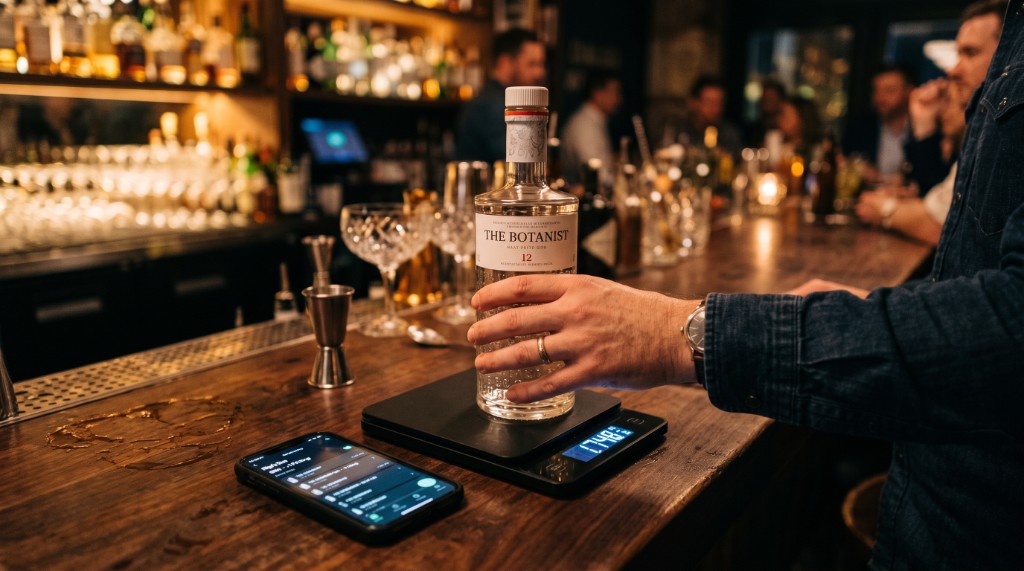
Key takeaways for managers (TL;DR)
- Visual estimation of open liquor bottles introduces a systemic 8% to 15% error margin due to bottle neck taper and shift fatigue.
- The Cornell Center for Hospitality Research documents average unmetered bar shrinkage between 18% and 24%, predominantly disguised as rounding errors.
- True digital precision requires specific gravity compensation: alcohol (0.789 g/ml) weighs significantly less than sugar-dense cordials (1.150 g/ml).
- Industrial Bluetooth 5.2 scales with automated tare subtraction reduce a 150-bottle audit from 2.5 hours of disputed manual estimates to under 14 minutes.
- Shifting from monthly audits to weekly shift-level reconciliations closes the feedback loop and typically recovers 3% to 5% of gross beverage margins within 30 days.
1. The Anatomy of Unmetered Bar Shrinkage
In high-volume hospitality, distilled spirits represent both the highest gross margin category and the single largest operational leak. While draft beer lines suffer from foaming and wine oxidizes after opening, spirits do not spoil. Every missing centiliter represents lost cash margin.
According to data compiled by the Cornell Center for Hospitality Research, average shrinkage in commercial bar operations runs between 18% and 24%. This drain rarely stems from overt theft; instead, it compounds through three routine operational habits:
- Uncalibrated Free-Pouring: Heavy pours during peak rush hours to secure higher customer gratuities.
- Unrecorded Comps and Spillage: Hospitality rounds and broken glassware that staff fail to enter into the point-of-sale register.
- The Tenths Estimation Method: The pervasive practice of picking up an open bottle, holding it to the light, and guessing its remaining volume as “0.4” or “0.7”.
Behind the shield of rough tenth-of-a-bottle estimation, chronic inventory leakage remains completely invisible until end-of-month financial statements arrive.
2. Why Visual Eyeballing Fails the Math Test
The traditional method of taking bar inventory relies on staff visually dividing each bottle into ten imaginary increments. On paper, this sounds reasonable. In reality, it violates basic geometry and physics.
2.1 Non-Linear Bottle Geometry
Liquor bottles are not uniform cylinders. A bottle of Belvedere or Hendrick’s Gin features wide shoulders, a narrow neck, and a heavy glass punt at the bottom.
A single vertical centimeter near the neck contains less than 15 milliliters of liquid, while a single vertical centimeter near the base contains over 90 milliliters. Asking a tired bartender at 2:30 AM to estimate whether a liquid line sits at 0.3 or 0.4 introduces an unavoidable 8% to 15% error margin on every single open bottle.
2.2 Shift Fatigue and Subjective Bias
When multiple staff members participate in weekly counts, consistency evaporates. One bartender rounds up to avoid manager scrutiny; another rounds down out of caution. Across a back-bar of 200 open spirits and cordials, compounding rounding errors introduce hundreds of missing milliliters of variance that cannot be traced to actual consumption.
When inventory records are based on guesswork, managers cannot hold staff accountable. Disputed counts lead to defensive staff meetings, unverified accusations, and zero operational improvement.
3. The Science of Precision Bluetooth Weighing
To eliminate estimation variance, OneDown pairs native mobile software with industrial-grade Bluetooth 5.2 weighing hardware. Rather than guessing volume, the system determines exact liquid contents through calibrated mass measurement.
3.1 Calibrated Tare Subtraction
Every liquor brand uses distinct glass packaging. A 700ml bottle of Patrón Tequila features thick, hand-blown artisanal glass weighing upwards of 620 grams empty, whereas a 700ml standard speed-rail vodka bottle may weigh only 340 grams.
OneDown maintains an active tare database containing empty glass weights for thousands of commercial spirits, liqueurs, and aperitifs. When a bottle is weighed, the software instantly subtracts the empty bottle tare.
3.2 Specific Gravity and Density Conversion
A fundamental flaw in amateur weighing setups is assuming that 1 gram of liquid equals 1 milliliter of volume. While true for pure distilled water at 4°C, this assumption fails in bar inventory:
- High-proof spirits (40% ABV) have a specific gravity of approximately 0.789 to 0.940 g/ml (alcohol is lighter than water).
- Sugar-dense liqueurs and cordials (such as Baileys Irish Cream, Kahlúa, or triple sec) have a specific gravity ranging from 1.050 to 1.150 g/ml due to dissolved sucrose.
OneDown’s conversion engine applies each spirit category’s specific gravity curve to the net weight in real-time, displaying exact liquid volume down to the milliliter in under 800 milliseconds.
4. The 14-Minute Speed-Rail Workflow
High-tech hardware is worthless if it slows down closing procedures. OneDown was engineered specifically for high-speed bar stations:
- Instant SKU Identification: The bartender scans the bottle’s EAN-13 barcode using the device camera or taps the visual speed-rail grid.
- Sub-Second Plate Settle: The bottle is placed onto the wireless scale. The strain-gauge load cell stabilizes in under 800 milliseconds.
- Automatic Local Commit: The converted quantity records immediately into the local database without waiting for network confirmation.
- Immediate Next Step: The app plays an audio chime and advances to the next bottle in the rail automatically.
A standard three-well cocktail bar with 150 open bottles that historically required 2.5 hours of manual notation is fully cataloged, verified, and locked in less than 14 minutes.
| Operational Metric | Manual Tenths Eyeballing | OneDown Smart Scale Engine |
|---|---|---|
| Measurement Precision | ±10% to 15% estimated variance | ±0.5 grams (sub-milliliter mathematical accuracy) |
| Audit Speed per 100 Bottles | 75 to 90 minutes of manual logging | 8 to 11 minutes uninterrupted workflow |
| Bottle Geometry Compensation | None (assumes uniform cylinder) | Exact tare database per brand and SKU |
| Density & Sugar Correction | Ignored (inaccurate volume estimates) | Automated specific gravity conversion |
| Audit Integrity | Disputed subjective notes | Timestamped digital records per operator |
| Variance Resolution | Delayed until monthly P&L review | Real-time shift & station level discrepancy |
5. From Guesswork to Real-Time Margin Protection
The greatest benefit of digital precision is frequency. When taking inventory takes two hours of arguing over bottle levels, venues count once a month at best. A thirty-day audit window gives chronic shrinkage an entire month to compound unchecked.
When a full audit takes under a quarter of an hour, bar managers can count every Sunday night or even at every shift handover. By reconciling physical depletions directly against sales recorded in the POS system (such as Remaris or Micros), management can pinpoint exact discrepancies by bartender, station, and cocktail recipe.
Closing this feedback loop immediately changes team behavior. When staff know that open liquor is measured to the single gram rather than roughly estimated, free-pouring stabilizes, portion control returns, and profit margins recover naturally.
§Official sources & references
All benchmarks, tax rules, and percentages cite official regulations and audit reports:
- [1]Cornell Center for Hospitality Research — Precision Pouring and Beverage Cost Control
Comprehensive study quantifying bartender portion variances, over-pouring patterns, and shrinkage dynamics in high-volume cocktail programs.
- [2]National Restaurant Association — Beverage Variance and Shrinkage Audit Benchmarks
Industry standards demonstrating average 15-20% shrinkage rates across commercial bar and restaurant environments.
- [3]Distilled Spirits Council of the United States (DISCUS) — Commercial Operations & Loss Control
Operational guidelines for spirit inventory integrity, bottle tare weight standards, and specific gravity conversions.